Leonardo da Vinci is arguably the most brilliant mind to have ever lived. His contributions to science, anatomy, and art remain the cornerstone of Western culture. While his legacy is immortalized in Florence, Vinci and Milan, a new scientific breakthrough is bringing the master back to life in an entirely different way: through his DNA.
Recent reports from researchers in early 2026 claim to have traced Da Vinci’s living descendants and identified his genetic sequence, sending shockwaves through the historical community. But for the modern traveler, this isn’t just a scientific curiosity – it is a development that could fundamentally alter the landscape of Italian tourism. As we look toward the future of travel, here are two scenarios of how this discovery might reshape the traveler’s experience.
Why Leonardo Da Vinci’s DNA discovery is a game-changer for Italian tourism
Scenario 1: The Rise of High-Tech Hagiography
The most immediate impact involves the evolution of the museum experience. Currently, visitors flock to see the Last Supper with a sense of reverence for a ghost. With confirmed DNA, curators could transition from static displays to deeply personal, immersive “biological” exhibits.
Imagine walking through a gallery where biometric data allows for a hyper-accurate reconstruction of Leonardo’s physical presence. Tourism in Italy could shift toward “Genetic Pilgrimages“, where travelers visit specific sites not just for the art, but to engage with the biological essence of the man himself. This would likely increase foot traffic to lesser-known ancestral villages in Tuscany, spreading the economic benefits of tourism beyond the congested city centers.
Scenario 2: Ethical Authenticity and the “New” Art Trail
The second scenario focuses on the “Quest for the Real.” For decades, the art world has debated the authenticity of various works attributed to Leonardo da Vinci. Parts of DNA evidence found on various canvases or notebooks could finally settle these disputes.
For the luxury traveler in Italy, this creates a new, verified “Da Vinci Trail.” If a previously overlooked sketch in a small-town archive is suddenly confirmed via genetic residue to be a genuine Leonardo, that town becomes an overnight popular destination. Italy could see a surge in “Scientific Tourism“, where the draw isn’t just beauty, but the absolute, undeniable proof of a genius’s touch. This adds a layer of intellectual “clout” to the Italian itinerary that appeals to the sophisticated, modern wanderer.
Ultimately, the discovery of Leonardo’s DNA bridges the gap between the 15th century and 2026. It transforms Italy from a museum of the past into a living laboratory where history is literally in the air—and the genes.
Significant Leonardo da Vinci-related artworks and museums you can visit in Italy
Find below a curated list of places you can visit which display arts of Leonardo da Vinci in Italy. Please note that these are the ones that have been linked to Leonardo in the past. Perhaps there will be additions in the future if more artworks can be linked and traced back to him in the future thanks to Leonardo da Vinci’s DNA Analysis.
1. The Last Supper (L’Ultima Cena) – Milan
- What to see: Leonardo’s most famous mural painting, depicting Jesus and the Apostles at the Last Supper (1494–1498).
- Where: Santa Maria delle Grazie, Milan (UNESCO World Heritage Site).
- Notes: Tickets are limited and must often be booked months in advance due to strict conservation rules and timed entry.
2. Museo Nazionale Scienza e Tecnologia Leonardo da Vinci – Milan
- Why visit: Italy’s largest science and technology museum has the world’s largest permanent exhibition of models based on Leonardo’s designs — from flying machines to mechanical devices built from his codices.
- Highlights: Engineering models, interactive displays, historical context on his scientific mind.
3. Leonardo3 – The World of Leonardo da Vinci – Milan
- Why visit: An interactive museum within Galleria Vittorio Emanuele II focused on Leonardo’s inventions and artistic vision, with 3D reconstructions and virtual experiences.
4. Museo Leonardiano di Vinci – Vinci (near Florence)
- Why visit: Located in Leonardo’s birthplace (Vinci), this museum showcases 60+ models built from his drawings, with digital and interactive exhibits that bring his ideas to life.
5. Leonardo da Vinci Museum (Florence)
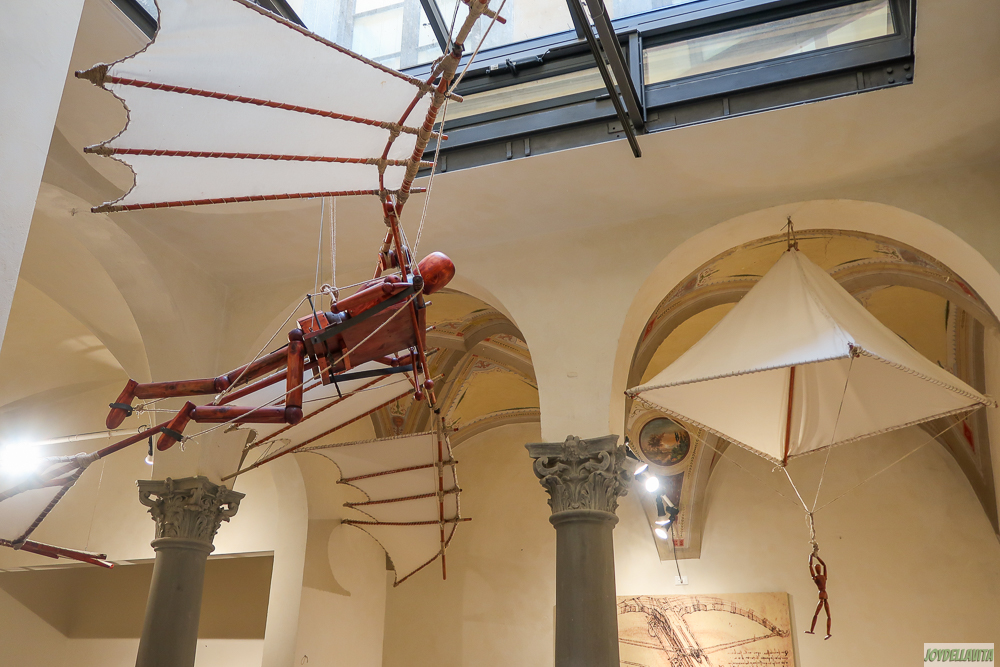
- Why visit: A smaller but central museum (Via de’ Servi, Florence) with functional reconstructions of Leonardo’s machines and inventions, great for families and anyone curious about his engineering work.
6. Uffizi Gallery – Florence
- Leonardo works:
- Annunciation (early masterpiece)
- The Baptism of Christ (Leonardo’s contribution alongside Verrocchio) and other studies in the Prints & Drawings collection.
- Why visit: One of the world’s oldest and most important galleries of Renaissance art, with a dedicated Leonardo room.
7. Pinacoteca Ambrosiana – Milan
- Significant holdings:
- Codex Atlanticus — Leonardo’s largest collection of drawings and writings, displayed on rotation.
- Why visit: Rare opportunity to see original manuscripts and technical sketches that reveal his artistic and scientific processes.







Leave a Reply