
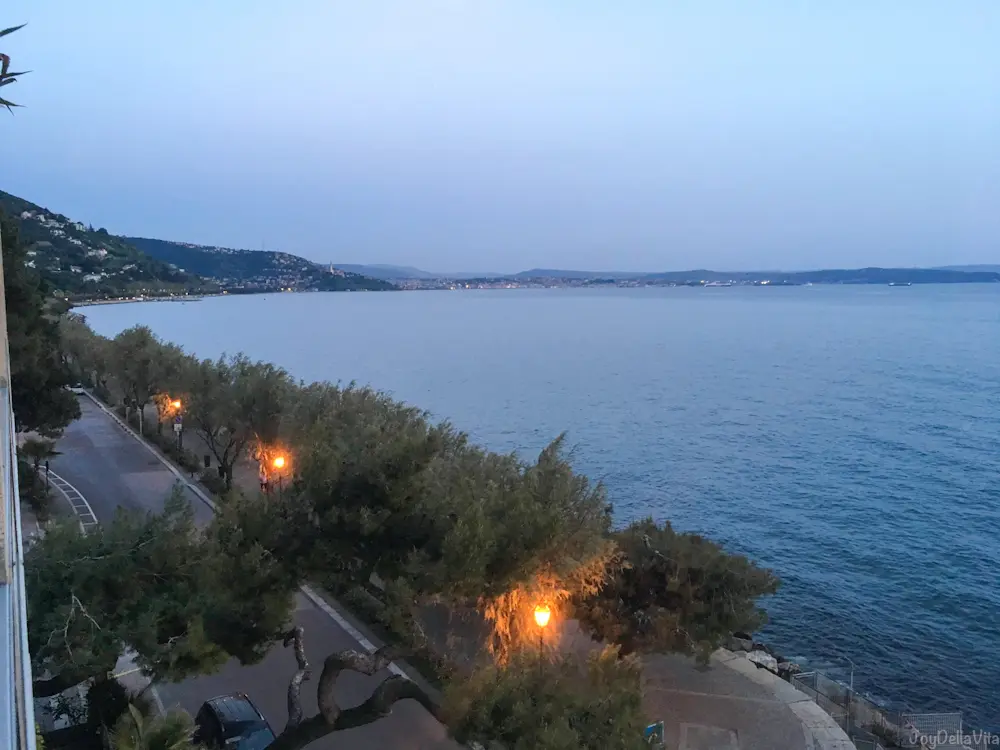
There’s a moment in Trieste when you realise everyone else knows something you don’t. Locals walk close to the buildings. Nobody carries an umbrella, even though the sky looks dramatic. And the café terrace on the waterfront? Chairs stacked, tables gone.
Then the first gust hits. And suddenly it all makes sense.
On 2 November 2026 it hit hard. ANSA reported gusts above 100 km/h and around thirty fire-brigade call-outs within a few hours. For Trieste, that counts as a busy day. Not a strange one.
What is the bora wind in Trieste?
The bora is a cold, dry wind from the east-northeast. It doesn’t build up gently like a sea breeze. It falls: cold air piles up behind the Karst plateau and then pours down towards the Gulf of Trieste. Meteorologists call that a katabatic wind. I call it the reason my hair never looks good in Trieste photos.
According to the regional weather service ARPA FVG, gusts in the city often top 110 to 120 km/h and occasionally reach 160 to 170 km/h.
Locals tell two kinds apart. Bora chiara comes with blue skies and crisp air. Bora scura brings clouds, rain or even snow. The gentle version gets a cute nickname, borin. There’s even a dialect word, imborezà, for someone full of energy. Supposedly that’s the wind’s doing.
When does the bora blow?
Mostly between October and March, with winter as peak season. But it doesn’t read the calendar. Trieste has seen 110 km/h gusts in mid-May. An episode can be over in an afternoon or drag on for days. In February 2012 it blew for more than two weeks straight.
How to handle the bora as a visitor
Check the forecast like a local
The regional weather service OSMER ARPA FVG publishes forecasts and wind warnings. If it says bora forte, plan museums, cafés and long lunches.
Walk smart
Stay on the sheltered side of the street and use the handrails. On some steep streets you’ll still spot the old ropes that once helped people stay on their feet. Leave the umbrella at the hotel; it won’t survive. Bring a hood, a hat that ties, and sunglasses against the dust. Avoid tree-lined parks and scaffolding, because falling branches and loose roof parts are what keep the firefighters busy. And as tempting as the Molo Audace is, admire it from a distance when gusts are strong.
Expect your plans to wobble
Boats such as the Delfino Verde to Muggia can be suspended, and outdoor seating disappears fast. Build in a little slack.
Enjoy the upside
Bora chiara days give you the clearest views of the year, sometimes with snowy mountains across the gulf. For the full story, book a visit to the tiny Bora Museum (Magazzino dei Venti). It works by appointment only, and nobody leaves without learning to make a pinwheel.
And when it all gets too much, do what the Triestini do: duck into a café. This is Italy’s coffee city, so brush up on why Italian espresso hits differently and when it’s okay to order a cappuccino.
Trieste wouldn’t be Trieste without it
Honestly, a calm day in Trieste is lovely. A bora day is unforgettable. Pack layers, follow a few Trieste Instagram accounts for live wind reports, and find more ideas for the region in my Friuli Venezia Giulia posts.
FAQ Bora Wind in Trieste: Your Questions Answered
What is the bora wind?
The bora is a cold, dry, gusty wind that blows from the east-northeast down from the Karst plateau into the Gulf of Trieste. It’s a katabatic wind, meaning cold air flows downhill and speeds up as it falls. Trieste is the Italian city most associated with it, and locals see it as part of the city’s identity.
How strong is the bora in Trieste?
Gusts often exceed 110 to 120 km/h and occasionally reach 160 to 170 km/h, according to ARPA FVG. A strong episode on 2 November 2026 brought gusts above 100 km/h and around thirty fire-brigade call-outs in a few hours.
When is bora season in Trieste?
The bora blows mostly between October and March, especially in winter. It can still appear in spring or early summer, usually more gently. The light summer version is called borin.
Is it safe to visit Trieste when the bora is blowing?
Yes, as long as you take a few precautions. Stay on sheltered pavements, avoid parks with big trees and the edge of the Molo Audace during strong gusts, and skip the umbrella. On days with strong-wind warnings, plan indoor activities and expect some ferry cancellations.
Where can I check the bora forecast for Trieste?
OSMER, the weather service of ARPA FVG, publishes regional forecasts and wind warnings at meteo.fvg.it. Check it the evening before and again in the morning, because conditions can change within hours.
What is the Bora Museum in Trieste?
The Magazzino dei Venti, on Via Belpoggio, is a small museum dedicated to the bora and to wind in general. It opened in 2004 and visits are by appointment only. Expect anemometers, wind-themed curiosities and a collection of “bottled” winds from around the world.






Leave a Reply